The task of writing a blog about the Hurtigruten ship, which we are taking from Kirkenes to Svolvær in the Lofoten Islands, has fallen to me because Ben has been largely a) seasick, b) drowsy or c) seasick and drowsy while we have been on board.
Before anyone worries too much, though, Ben is really OK now. He’s even off the drowsy medication. It was just the first day (1 of 3) when he was unwell, and then yesterday I just woke him up to feed him, if we were somewhere particularly picturesque, or if we were at a port and had time to look around.
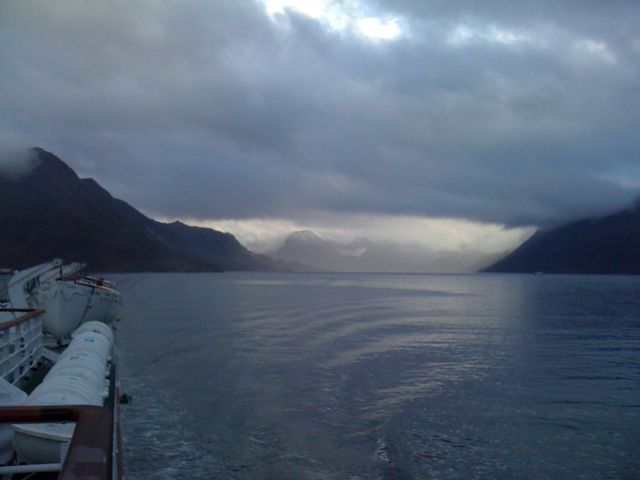
The Hurtigruten runs up and down the extremely scenic Norwegian coast from Kirkenes to Bergen, and is a cross between a ferry and a cruise-ship, depending on whether you are a Norwegian trying to get somewhere or a retired tourist doing a two week return journey with fancy meals included.
I think we have been unlucky because when we first got on the ship they were announcing warnings over the speakers, cancelling meals and drawing pictures of terrified seasick people to illustrate the weather forecast printouts.
We are travelling on the smallest ship of the fleet, MS Lofoten, with only 150 berths, to reduce the cruise-contingent and because we were late in booking by Hurtigruten standards! This has also reduced the amenities (notably, no stabilisers…) but it’s exciting to be on such a small ship. When we pass Hurtigruten ships going in the other direction they tower over us like skyscrapers.
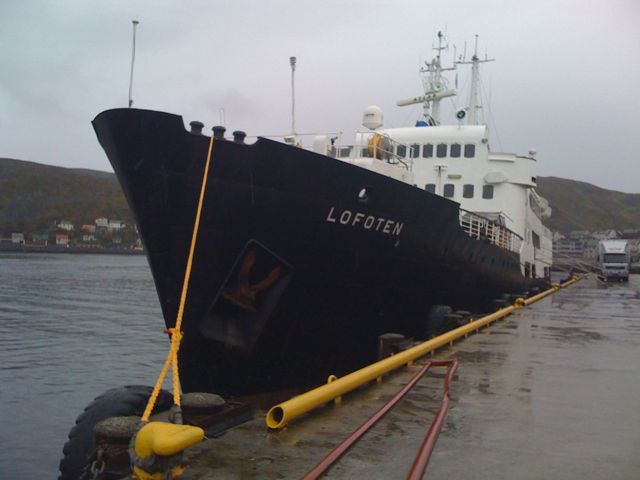
Yesterday we visited the northernmost point in Europe, Nordkapp or North Cape, and joined The Royal and Ancient Polar Bear Society, something which can only be done in Hammerfest, the world’s most northerly town. Neither of these are quite what they seem.
Nordkapp is forced to qualify its claim by saying ‘mainland’ Europe, because otherwise Svalbard, last stop before the Arctic, wins hands down. So it was quite surprising to discover it is on an island which has only recently been connected to the mainland via a 7km tunnel. And, in any case, it turns out the next peninsular along is slightly more northerly, as the British Explorer who discovered it a few hundred years ago made a mistake (he was also aiming to get to India, so all in all the trip was not a great success). Anyway, as the actual northernmost point is inaccessible to cars and so is quietly ignored. Nordkapp is, nonetheless, very beautiful and we were there at dawn to see a gorgeous sunrise.
As for the Royal and Ancient Polar Bear Society, it was founded in 1963 so it’s actually rather recent!
Since we last blogged we’ve also been staying in a little wooden cottage in a small place in Northern Finland, Inari, where we learned more about the local Sàmi people, who probably came from Mongolia about 8000 years ago. This wasn’t a big surprise as you don’t encounter all that many nomadic, animal-husbandry enthusiasts living in circular tents these days.
We went on a boat trip on the beautiful Lake Inari (pleasingly pronounced Inari-yari in Finnish) and hiked to a wilderness church built in 1752. It was quite amazing to find a wooden church in the middle of a meadow surrounded by dense forest, and the hiking facilities were quite something. As well as regular shelters/toilets and marker posts along the trail, there were day huts with cooking facilities and wood-burning stoves, and even a sauna! The marker posts were so frequent that we started trying to find spots where you couldn’t see one. This almost invariably went “I can’t see a post! – oh no, wait, actually I can see one… no, two”.
We also went to Kirkenes museum and discovered that Norway had also been quite thoroughly screwed over in WWII. I don’t think we can take any more recent history museums and can quite authoritatively state that pretty much everyone was miserably screwed over. We can confidently state that the whole of northern Scandinavia was utterly destoyed, and perhaps this goes some way to excusing Santa for the sorry state of Santa Claus Village.
Santa Claus Village must have been a prime target for the Nazi war machine! Santa probably has a secret bunker for all Santa Claus Corporation Employees so they survived the ordeal.